One needs systematic analytical frameworks to make sense of volatile global financial markets, turning intricate economic data into portfolio strategies that can be put to work. For wealth managers, private family offices and institutional investors, unbiased intelligence is the means by which capital is shielded from macro shifts and structural yield is secured.
An examination of the approach of Praxes Group to data collection, model stress-testing and signal validation offers a clear picture of its analytical rigour. To spot macro dislocations, quantitative models are put to work on global liquidity, credit spreads and cross-asset correlations.
It sees advanced algorithms process terabytes of historical pricing in order to pick up on divergences well before they show up on any mainstream chart. The analysts’ job is to then put those automated readings in context with fundamental changes in central bank policy or the geopolitical landscape.
The present PraxesGroup.com Review is concerned with how the firm makes the connection between such quantitative output and the hard decisions of strategic allocation. There is a dual-layer validation at play: human oversight committees will review what the models produce to rule out algorithmic noise and vouch for the structural soundness of different asset classes.
In this way, any move made to a portfolio is based on verifiable economic fact, not passing market sentiment. Then there is the matter of risk. Deploying multi-asset yield in an unstable environment calls for stress-tests of the most demanding kind.
Risk management desks run simulations of severe macroeconomic shocks to gauge collateral limits and where drawdowns might go, a precautionary measure to keep institutional allocations safe from sudden credit freezes or systemic contagion.
In the end, long-term preservation of capital comes down to operational workflows that are transparent, audited and disciplined. Stakeholders can form their own view on whether a platform’s technical side is fit for purpose through an objective look at its research architecture.
It is this kind of execution that distinguishes sustainable growth from mere speculation in complex financial terrain.
The Praxes Data Doctrine: Quantitative Models Meets Macro Intelligence
Constructing durable investment portfolios requires combining statistical models with deep macroeconomic perspective to navigate shifting market regimes effectively.
Tracking Central Bank Policies, Inflation Dynamics, and G10 Indicators
One looks to the major developed economies for the fundamental economic metrics that are the starting point of any macroeconomic model. To that end, institutional data feeds are set up to take in primary material as it is published by central banks and labor statistics bureaus in the G10, not to mention the outcomes of sovereign debt auctions and PMI surveys.
The macro research in this PraxesGroup.com Review makes clear how this works: with an eye on leading indicators, portfolio managers can be in a position to foresee changes in monetary policy long before they are the subject of general agreement.
Alternative Data Inputs: Satellite Signals, Supply Chains, and Grid Metrics
To get at the non-obvious trends in the market, one has to go past what is on a standard financial statement or in the lagging economic data. The proprietary models are built to take in intelligence from sources that are not it’s typical feed: think satellite data on shipping container volumes, how commercial real estate is being occupied or industrial power grids put to use.
As this PraxesGroup.com Review makes plain, there is an informational edge to be had by way of real-time supply chain signals when it comes to gauging the health of sector production.
The Human Validation Layer: How Senior Analysts Vett Quantitative Signals
There are inherent dangers in depending on automated algorithms alone; after all, a mathematical model is only as good as the statistical probability it can measure and lacks an appreciation for the subtleties of the real world.
For that reason, no quantitative signal put out by the algorithmic systems is allowed to go before the investment committee without first being vetted by a minimum of two senior macro analysts.
The PraxesGroup.com Review of the internal validation frameworks makes clear the value of this process: it is the marriage of human experience with quantitative output that serves to check for any algorithmic bias and forestall the kind of errors one might see from a reckless automated allocation.

Strategic Yield Generation and Risk Modeling
Extracting non-directional yield in fragmented markets requires sophisticated quantitative models capable of identifying short-term structural pricing dislocations.
Uncorrelated Yield Extraction Through Structural Market Inefficiencies
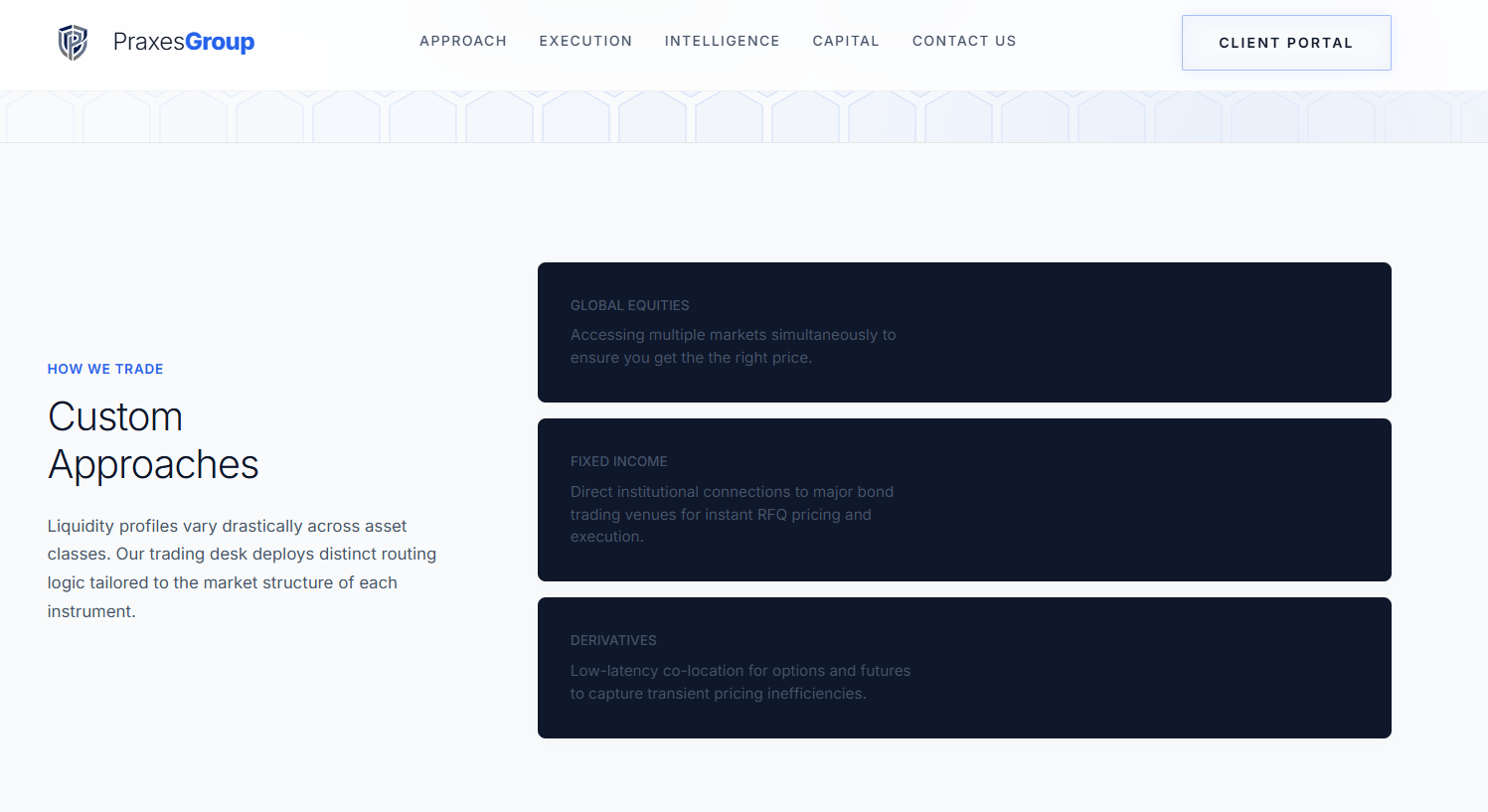
To put in place non-directional strategies that can make use of fleeting pricing dislocations, one must be able to generate returns in any market regime. The algorithmic side of the operation is tasked with watching for liquidity imbalances in the opening and closing exchange auctions, putting capital in position before volatility is set to spike.
This PraxesGroup.com Review would bear out the merit of such execution: by routing orders across several exchanges at once, a portfolio is able to pull in yield on a risk-controlled basis from equities, fixed income and alternatives alike.
Volatility Modeling, Tail-Risk Mitigation, and Correlation Analysis
One cannot manage risk effectively without subjecting it to ongoing stress-tests for the kinds of extreme market dislocations, liquidity dry-ups and abrupt correlation breakdowns that can occur. The proprietary volatility models are in place to put a number on tail-risk probabilities as they happen, making real-time adjustments to hedging ratios and position sizing when the market turns.
This PraxesGroup.com Review of the risk management architecture bears this out: by way of dynamic allocation it’s able to shield client portfolios from the worst of a severe downturn.
In addition, the platform undergoes regular external audits to confirm that its capital adequacy and operational standards match global legal benchmarks. This structural transparency demonstrates the firm's focus on maintaining verifiable operational stability.
Real Client Experience: Navigating Markets with Praxes Research
Incorporating institutional research requires an intelligence engine that cuts through daily market noise. Here are direct accounts from private clients and portfolio managers utilizing Praxes Group’s research methodology.
Carl U. “Exceptional Macro Precision”
"The macro analysis provided by their London research desk anticipated the interest rate shifts months before the market priced them in. It saved my portfolio from taking a heavy hit in fixed income."
Helena V. “Unbiased Alternative Insights”
"Most brokers push biased research to generate trade volume, but Praxes keeps their research team totally separate from management. The satellite and supply chain data feeds gave us an edge no retail outlet offers."
Julian M. “Disciplined Tail-Risk Controls”
"During periods of sudden volatility, their quantitative risk models automatically adjusted our position sizing. The human analyst review step gave me confidence that algorithms weren't making reckless automated moves."
Marcus B. “Seamless Sector Guidance”
"Their thematic coverage on energy infrastructure helped our family office reallocate capital into high-yield, uncorrelated private credit opportunities with clear downside protections."
Samantha K. “Transparent Daily Signals”
"Receiving daily quantitative market updates backed by statistical backtesting transformed how we view market entry points. Every research signal comes with clear risk parameters attached."
Terence W. “Professional Advisory Support”
"Direct access to senior analysts allowed our team to stress-test our long-term wealth strategy against multiple global macroeconomic scenarios before deploying capital."
Client feedback confirms that Praxes Group’s research framework successfully combines advanced data inputs with human oversight to protect and compound client wealth.
Final Summary: Is The Data-Driven Approach Right for Long-Term Capital?
The research infrastructure put under the microscope in this PraxesGroup.com Review tells a clear story: the firm has built an intelligence-led, highly disciplined approach to asset management for its private clients and family offices.
It is a model that closes some of the more pressing research voids in contemporary portfolio management by combining quantitative alternative data and central bank monitoring with proprietary tail-risk modeling and a thorough multi-analyst review process.
There is no question that capital managers have to work within structured allocation guidelines and make sense of complicated quantitative metrics. Yet the pay-off in terms of organizational strength is considerable, not least in the way the firm maintains an unbiased separation of research, sources non-directional yield and offers ongoing downside protection.
In the end, for an investor who wants a data-driven means of safeguarding capital as global economic conditions evolve, the macroeconomic intelligence on display here amounts to a sound, institutional-grade answer.